
Ten Years of the Philippine Competition Act
Today marks a decade since the enactment of the Philippine Competition Act (“PCA”)[1] on July 21, 2015. As the country’s competition policy framework, the PCA was enacted to address the overconcentration of wealth in the country by regulating monopolies and prohibiting anti-competitive conduct while ensuring that businesses thrive through healthy competition.
El Cid Butuyan, Founding Commissioner of the Philippine Competition Commission (“PCC”)—the independent regulatory and quasi-judicial agency under the PCA—provides further insight into the relevance and workings of the PCA in Taming Oligopolies Through Competition Law,[2] published in the Philippine Law Journal in 2018. While the PCA lacks an explicit definition of “competition,” Butuyan characterizes it by referring to an ideal theoretical benchmark known as “perfect competition”—a useful tool in evaluating the presence and quality of competition within an industry. This envisions a market where no single seller or buyer is able to influence the price of a particular product or service and businesses are able to freely enter and exit the market.[3] Although achieving perfect competition is “unrealistic” at best,[4] the endeavor to strive for perfect competition produces outcomes greatly beneficial for both sellers and consumers alike, a principle recognized by framers of the Constitution when they crafted its competition provision where “[t]he State shall regulate or prohibit monopolies when the public interest so requires. No […] unfair competition shall be allowed.”[5]
The PCA achieves this by vesting the PCC with three main powers: (1) the power of enforcement, which is the authority granted to undertake fact-finding or preliminary inquiries concerning anti-competitive agreements and abuse of dominant position by firms,[6] (2) the power to review or prohibit mergers and acquisitions that “substantially lessen competition,”[7] and (3) the mandate to advocate for fair competition through the National Competition Policy.[8]
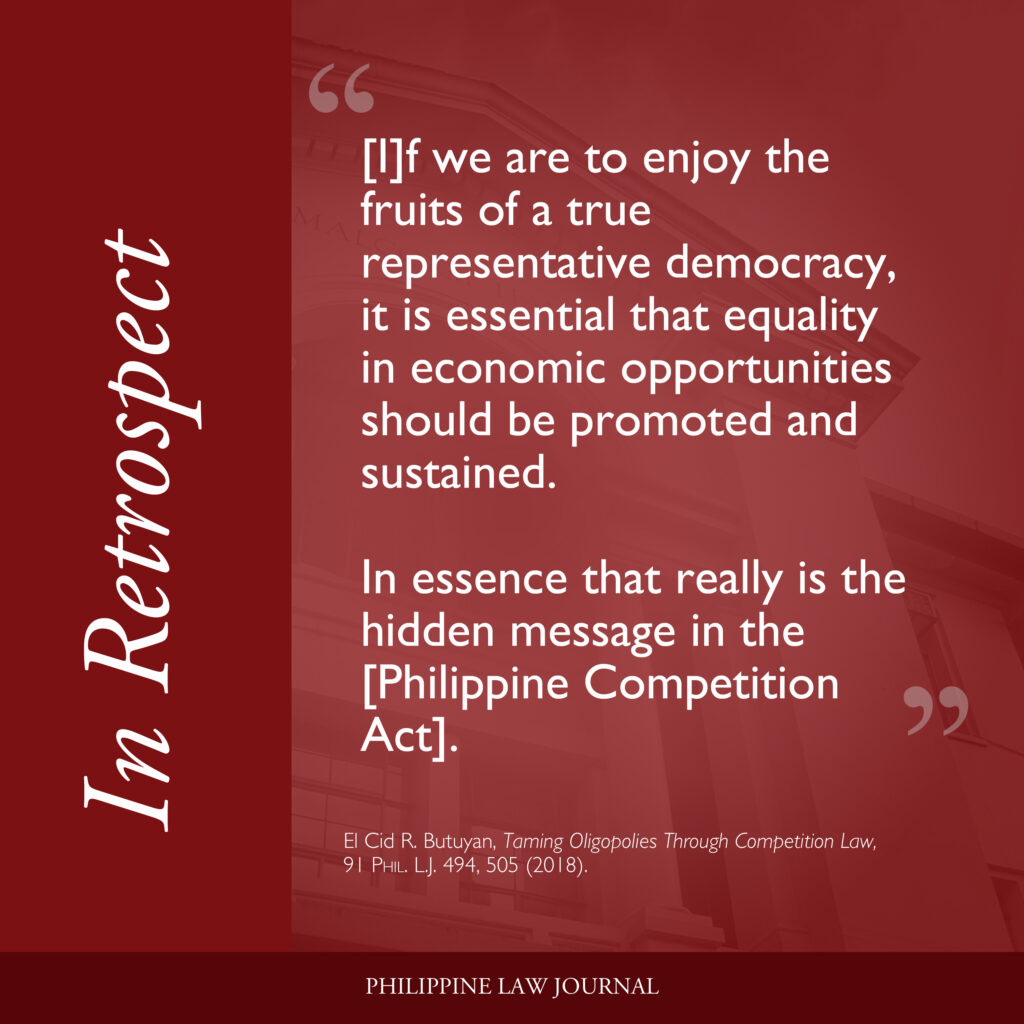
To Butuyan, the promotion of competition, with all its consequences and implications, are rooted in the promotion of democracy.[9] After all, an abusive monopoly leads to concentration of economic power and subsequently, significant political influence that can erode democratic values and freedoms. Thus, he posits that if the democratic character of the country’s institutions is to be preserved and “if we are to enjoy the fruits of a true representative democracy, it is essential that equality in economic opportunities should be promoted and sustained. In essence that really is the hidden message in the PCA.”[10]
Since then, gaps and loopholes remain consistent challenges for the PCA and the PCC. Krystal Lyn Uy’s article The Philippines’ Anti-Trust Regulation Relating to Minority Shareholdings: Is There an Enforcement Gap?,[11] for instance, highlights a key issue with the PCA and how the PCC handles merger control in relation to minority shareholdings. Minority shareholdings, Uy asserts, may still carry the risk of substantially lessening competition, especially in markets with high barriers to entry or those where collusion between firms is likely.
Uy suggests three solutions to remedy what she sees to be an enforcement gap. First is lowering the review threshold following the standard of the European Commission, which has a more robust regulatory scheme as regards minority shareholdings.[12] The second is to allow the PCC to review non-controlling transactions. The last solution is to prohibit “competitive interlocking,” where competing firms share common directors and officers—a practice that facilitates coordination of behavior and other forms of anti-competitive influence. While the Philippines has already recognized the danger of interlocking directors in Gokongwei v. SEC,[13] there is still no explicit prohibition on competitive interlocking.
Works such as Uy’s highlight the immaturity of the Philippine competition law regime, although other scholars have noted the PCA’s potential to address sector-specific commercial issues. In This Is Not a Sponsored Post: Misuse of Data and Its Role in Creating Internet Hegemonies,[14] published in the Ateneo Law Journal, for example, Maria Carmela Suarez argues that the prohibition of abuse of dominant position under the PCA can be used to curb the predatory data-gathering practices of tech giants such as Facebook and Google.[15] Because these firms not only impose conditions upon consumers that are “impossible to refuse,”[16] ultimately functioning as a contract of adhesion,[17] but also prevent other companies (including other social media and advertising companies) from accessing data gathered from their own platforms,[18] they effectively “wall off competition” and impose barriers to entry on other tech firms, which prevent them from growing within the digital market.”[19]
Interestingly, both European and American competition regimes—which heavily influenced the PCA—endeavored to hold these companies liable for their data practices. Suarez discusses the Bundeskartellamt’s[20] finding that Facebook violated the General Data Protection Regulation of Europe[21] by abusing its dominant power in imposing unfair terms and conditions.[22] Similarly, the European Commission had already penalized Google for violating their antitrust rules through several exclusionary and anti-competitive acts.[23] Ultimately, Suarez forwards the same arguments and posits that these practices, being anti-competitive, should require intervention from the Philippine government—whether it be through the creation of a governmental committee that shall assess and review the companies’ algorithms and exclusive access to data, or the imposition of the compulsory notification requirement to all mergers and acquisitions with regard to websites and applications.[24]
In Tempering Dominance in the Marketplace of Ideas: The Application of the Philippine Competition Act in the Mass Media Industry[25] from the Ateneo Law Journal, Maria Graciela Base and Jose Maria Marella discuss how competition law could be applied to mass media. The authors contend that Philippine mass media is dominated by powerful societal interests that finance and control the distribution of ideas.[26] Far from being a space where truth emerges from the unencumbered competition of speech, the current marketplace is a captive market defined by structural inequality and limited access, ownership concentration, substantial barriers to entry, and vertical integration. These result in media conglomerates which do not only influence public discourse but whose respective owners possess interests across a wide variety of industries that may give rise to conflicts of interest in news reporting.[27]
It’s these structural imbalances that Mase and Barella argue warrant the application of the PCA. In light of these distortions, Base and Marella advocate for the PCA to be used as a legal framework not just for economic regulation, but also for the democratization of the public sphere. By enabling the PCC to intervene in cases of excessive media consolidation or exclusionary practices, the State can restore balance to the marketplace of ideas and uphold the constitutional guarantee that no unfair competition shall be allowed.[28]
Philippine competition law scholarship demonstrates both the numerous growing pains of the PCA and an anticipation for it to be actively used as means to achieve our nation’s collective economic interests. The PCC, in turn, has not been unheeding to these and the broader drive to develop our competition law regime. It has published numerous position papers, policy notes, and market studies supportive of these scholarly advocacies. Market studies released by the PCC in 2024, for instance, have discussed emerging issues such as the burgeoning monopolies in online advertising[29] as well as television advertising.[30] The PCC is also set to host the International Competition Network (“ICN”) Annual Conference in 2026, highlighting its thrust of utilizing cross-country partnerships to “accelerate […] collective effort for effective competition law enforcement, safeguarding businesses, consumers, and economies globally.”[31]
So far, the PCA has been able to adequately delimit what firms can or cannot do, with the PCC serving as an able regulator while facilitating competition law’s incremental developments. But whether this leads us closer to Butuyan’s concept of “perfect competition” and eventual deconcentration of economic power remain to be seen. Ten years on, our competition law regime now needs robust enforcement and sustained imaginative growth to ultimately fulfill its role in realizing the promises of our democracy.
This In Retrospect was prepared by Deo Cruzada, Joachim Regalado, and Mary Katherine San Miguel, under the supervision of Andi Holandez Mencias, Editor, Vol. 98, and with contributions from Iñaqui Angelo Mangahas, Vice-Chair, Vol. 98. This was written in collaboration with the Competition Law and Policy Program (CLPP) of the University of the Philippines College of Law. The PLJ Editorial Board extends its gratitude to CLPP Director Associate Professor Gwen G. De Vera and Atty. Charles David A. Icasiano for their inputs and guidance in the crafting of this piece.
In Retrospect is a series of thought pieces revisiting past Journal articles in light of recent developments in current affairs or related literature. They are written by PLJ interns, with guidance from the Editorial Board.
[1] Rep. Act No. 10667 (2015), § 1. The Philippine Competition Act.
[2] El Cid R. Butuyan, Taming Oligopolies through Competition Law, 91 Phil L.J. 494 (2018).
[3] Id. at 496.
[4] Id.
[5] Const. art. XII, § 19.
[6] Butuyan, supra note 2, at 496.
[7] Id. at 503.
[8] Id. at 504.
[9] Id., at 505.
[10] Id.
[11] Krystal Lyn T. Uy, The Philippines’ Antitrust Regulation Relating to Minority Shareholdings: Is There an Enforcement Gap?, 96 Phil L.J. 1 (2023).
[12] Id. at 12 n. 55, citing Eur. Comm’n, White Paper Towards more effective EU merger control. COM(2014) 449 (July 9, 2014)
[13] G.R. No. 45911, 89 SCRA 336, Apr. 11, 1979.
[14] Maria Carmela B. Suarez, This Is Not a Sponsored Post: Misuse of Data and Its Role in Creating Internet Hegemonies, 67 Ateneo L.J. 535 (2023).
[15] Id. at 549–50.
[16] Id. at 545.
[17] Id. at 546.
[18] Id. at 547.
[19] Suarez, supra note 14, at 559–60.
[20] Refers to Germany’s national competitive authority.
[21] Regulation 2016/679, 2016 O.J. L 119 1 (2016) (EU).
[22] Suarez, supra note 14, at 557.
[23] Id. at 557–59.
[24] Id. at 565–66, 568–69.
[25] Maria Graciela D. Base & Jose Maria L. Marella, Tempering Dominance in the Marketplace of Ideas: The Application of the Philippine Competition Act in the Mass Media Industry, 62 Ateneo L.J. 442 (2017).
[26] Id. at 443.
[27] Id. at 470–72.
[28] Id. at 444, 492–93.
[29] Jestoni A. Olivo, Phil. Compet. Comm’n. (PCC), Digital Platforms and Online Advertising: A Guide for Competition Policy (PCC Market Study No. 01, 2024), at https://www.phcc.gov.ph/storage/pdf-resources/1737107374_PCC-Market-Study-2024-01-Digital-Platforms-and-Online-Advertising_compressed.pdf.
[30] Shereena S. Salas & Gwyneth Mae R. Ramos, Phil. Compet. Comm’n. (PCC), Blocktiming Practices in PH Free TV Industry (PCC Market Study No. 02, 2024), at https://www.phcc.gov.ph/storage/pdf-resources/1737108542_PCC-Market-Study-2024-02-Blocktiming-Practices-in-PH-Free-TV-Industry.pdf.
[31] PCC Pub. Affs. & Research Div., Press Release, PCC to Host Global Competition Conference in 2026, Phil. Compet. Comm’n Website, May 14, 2025 at https://www.phcc.gov.ph/resource-details/pcc-to-host-global-competition-conference-in-2026.