
Revisiting the Condonation Doctrine, a Decade Since Carpio-Morales v. Court of Appeals
Carved into the very bones of Philippine law and born from the spirit of the People Power Revolution is the democratic principle declaring that “public office is a public trust.”[1] Public servants are expected to uphold the interests of their constituents and are compelled to uphold integrity, exercise responsibility, and remain accountable to the people at all times. That same trust is now under intense scrutiny. The onslaught of typhoons that left Metro Manila and nearby provinces underwater during the first half of 2025 has exposed corruption in the billions through flood control projects, involving public officers in all levels of government.[2] As the controversy reaches a fever pitch,[3] questions on public trust become increasingly relevant. One such question turns to the Supreme Court, as the guardian of the Constitution, and the direction of Philippine jurisprudence regarding the mandate of public trust and accountability.
Historically, the condonation doctrine allowed a public official to be absolved of administrative liability for misconduct committed during a previous term if they were re-elected.[4] This doctrine, introduced into the country in Pascual v. Provincial Board of Nueva Ecija,[5] held that re-election was a form of forgiveness by the electorate—effectively wiping the slate clean.
In his Philippine Law Journal article, A Re-Examination of the Doctrine of Condonation of Public Officers,[6] Miguel U. Silos challenged the Supreme Court’s overreliance on American jurisprudence in adopting the doctrine. Silos argued that while US courts occasionally leaned toward condonation, they did not uphold it as a universally applicable principle.[7] More importantly, the US legal framework recognizes that re-elected officials may still be held accountable, particularly when acting as their “own successors.”[8]
Despite these flaws in reasoning, the condonation doctrine gained traction and was reinforced in several Supreme Court decisions. In Lizares v. Hechanova,[9] the Court reiterated the doctrine without fully addressing the issue of continuing misconduct. In Aguinaldo v. Santos,[10] the doctrine rendered petitions moot and academic following Aguinaldo’s re-election, thus failing to enforce accountability. Similarly, in Reyes v. COMELEC,[11] the Court neglected the ongoing nature of the official’s alleged offenses. In Salalima v. Guingona,[12] the Court adopted a policy justification: shielding public officials from being “hounded by political enemies,” which further entrenched the idea that re-election erases past misconduct. Finally, in Garcia v. Mojica,[13] the Court shifted evidentiary rules by conclusively presuming that the electorate knew and accepted a candidate’s misconduct upon re-election, regardless of actual public awareness.
Silos criticized these developments, warning that the Court’s automatic application of the doctrine allowed officials to escape liability for serious misconduct, including malversation and misappropriation—acts that could be considered continuing offenses. He emphasized that the gravity of misconduct should be evaluated in relation to the office held and that re-election should not negate accountability if the offense compromises the integrity of the position.[14] He also posited that the doctrine fails to account for the fact that misconduct is usually hidden from the public and not revealed until after the officer has been re-elected.[15]
Silos also argued against the Philippine Supreme Court’s interpretation of the condonation doctrine as a matter of public policy. He contended that the condonation doctrine contradicted the strong public policy against corruption under the 1987 Constitution.[16] Although the notion of public office as a public trust was first introduced in the 1973 Constitution, the 1987 Constitution imposes stricter requirements, including, most notably, the mandate for public officers to “take positive and effective measures against graft and corruption”[17] and to “lead modest lives.”[18]
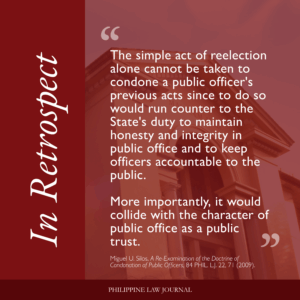
This tension continued until Carpio-Morales v. Court of Appeals,[19] where the Supreme Court finally abandoned the condonation doctrine. In its decision, the Court repeatedly cited Silos’ article, both in its historical and prudential analysis of the doctrine. The Court recognized that Pascual was decided under the 1935 Constitution, which emphasized the people’s right to vote without a corresponding obligation on those voted by the people,[20] and is “plainly inconsistent”[21] with the 1987 Constitution, which balances said right with accountability, integrity, and good governance. Furthermore, the Court highlighted that the doctrine does not reflect electoral realities, as condonation presumes actual knowledge, whereas voters are rarely aware of the misconduct of their elected officials.[22]
Silos’ article was pivotal to the Carpio-Morales decision, as Coleen Claudette R. Luminarias and Isa Maria N. Avanceña acknowledged in their Ateneo Law Journal article Carpio Morales v. Court of Appeals and Binay, Jr.: Why the Supreme Court Abandoned the Fifty-Six Year-Old Doctrine of Condonation.[23] Luminarias and Avanceña situated their analysis of Carpio-Morales in the foundational work of Silos, whose article they considered to be the intellectual precursor to the eventual legal shift. Indeed, they noted how the Ombudsman cited Silos in her supplemental petition in Carpio-Morales, which was later adopted by the Supreme Court.[24]
Similar to Silos, Luminarias and Avanceña argued that the Supreme Court’s decision to abandon the condonation doctrine was an overdue development that corrected a long-standing jurisprudential error. They contended that the condonation doctrine was a jurisprudential anomaly that lacked a sound legal basis and fundamentally contradicted the constitutional principle of public accountability. They framed the doctrine as a practice of impunity that allowed misdeeds to fester and perpetuated political dynasties.[25] In this light, the Supreme Court’s rejection of condonation in Carpio-Morales was not simply a legal correction but a moral imperative that restored coherence to the constitutional mandate that a public office is a public trust.[26]
However, while Luminarias and Avanceña “agree[d] with the abandonment of the condonation doctrine,”[27] they focused on whether Carpio-Morales solidified such abandonment as binding precedent. Luminarias and Avanceña raised the possibility of a future challenge to the decision, as the validity of the condonation doctrine was not the lis mota of the case. The authors based this line of reasoning on the dissenting opinion of Justice Bersamin, who argued the Supreme Court unnecessarily abandoned the condonation doctrine because the case could have been resolved on the narrower ground that the Court of Appeals misapplied it to a preventive suspension order.[28] The authors concluded, however, that the abandonment is binding precedent because it was explicitly and decisively stated in the dispositive portion of the Court’s decision.[29]
Overall, Luminarias and Avanceña characterized the condonation doctrine’s abandonment as a landmark victory for public accountability in the Philippines. They identified Carpio-Morales as a decisive turn that represented how “the Supreme Court was able to once again vindicate our Constitution and, more profoundly, the interminable fight against corruption and impunity in Government.”[30]
This decisive turn, however, is but one step on a long path to true public accountability. Eugene Kaw, in his Ateneo Law Journal article, The Wisdom Among Us: A Critical Examination of the Political Wisdom of the Filipino People and the Theory of Popular Sovereignty in Philippine Democracy,[31] offers a constitutional and philosophical inquiry into the meaning of popular sovereignty in the Philippine democratic order. Kaw cautions that, while sovereignty resides in the people and finds its clearest expression in elections, democracy should not be reduced to mere numbers. Indeed, while democracies worldwide rely on the “wisdom of crowds” to reflect sovereign will, poll results are often contingent on an interplay of various demographic factors.[32]
Kaw argues that even prior to elections, the electorate’s process of formulating its choice proves critical.[33] Yet he recognizes the electorate’s choices and preferences as valid,[34] thus advocating instead for strengthening institutions that protect and refine political wisdom. Sovereignty must therefore be exercised not only numerically but substantively, by improving voter education and information,[35] countering fake news and misinformation,[36] developing a stronger political party system,[37] and dismantling populist institutions.[38] Ultimately, accountability is not only about sanctioning officials but also about ensuring that the people’s sovereignty is exercised wisely.
Since Silos’ critical stance against the impunity enabled by the condonation doctrine, Philippine legal scholarship has since moved to further scrutinize Pascual and its theoretical underpinnings. Nonetheless, while the doctrine has been quashed in jurisprudence, as argued by Luminarias and Avanceña, scholars like Kaw warn that its perilous implications still loom over the mechanisms purported to exact accountability. These lessons are relevant now more than ever, especially as the investigations into the flood control projects continue to expose corruption deeply entrenched in political structures, stretching far and wide across local and national lines.
This In Retrospect piece was prepared by Quiel Endaya, Au Ferreras, Seij Ogata, and Israel Salvador, under the supervision of Jess Cuadro, Vol. 99, and with contributions from Josemaria Sebastian, Chair, Vol. 99.
In Retrospect is a series of thought pieces revisiting past Journal articles in light of recent developments in current affairs or related literature. They are written by Philippine Law Journal interns, with guidance from the Editorial Board.
[1] Const. art. XI, § 1.
[2] James Patrick Cruz, Ex-DPWH officials, contractors face criminal complaint over flood control mess, Rappler, Sept. 11, 2025, at https://www.rappler.com/philippines/dpwh-flood-control-officials-contractors-face-criminal-complaint/
[3] Joviland Rita, Black Friday protests held over ‘corruption’ in flood control projects, GMA News Online, Sept. 12, 2025, at www.gmanetwork.com/news/topstories/nation/958930/black-friday-protest-flood-control-projects corruption/story/.
[4] Miguel U. Silos, A Re-Examination of the Doctrine of Condonation of Public Officers, 84 Phil. L.J. 22, 56 (2009).
[5] 106 Phil. 466 (1959).
[6] Silos, supra note 4.
[7] Id. at 46.
[8] Id. at 48.
[9] G.R. No. 22059, 17 SCRA 58, May 17, 1966.
[10] G.R. No. 94115, 212 SCRA 768, Aug. 21, 1992.
[11] G.R. No. 120905, 254 SCRA 514, Mar. 7, 1996.
[12] G.R. No. 17589, 257 SCRA 55, May 22, 1996.
[13] G.R. No. 139043, 314 SCRA 207, Sept. 10, 1999.
[14] Silos, supra note 4, at 68.
[15] Id. at 67.
[16] Id. at 29.
[17] Const. art. II, § 27.
[18] Art. XI, § 1.
[19] [Hereinafter “Carpio-Morales”] G.R. No. 217126, 774 SCRA 431, Nov. 10, 2015.
[20] Id. at 540.
[21] Id. at 545.
[22] Carpio-Morales, 774 SCRA 431, 550.
[23] Coleen Claudette R. Luminarias & Isa Maria N. Avanceña, Carpio Morales v. Court of Appeals and Binay, Jr.: Why the Supreme Court Abandoned the Fifty-Six Year-Old Doctrine of Condonation, 61 Ateneo L.J. 204 (2016).
[24] Id. at 227.
[25] Id. at 208.
[26] Id. at 229.
[27] Id. at 240.
[28] Id. at 237.
[29] Id at 242.
[30] Id. at 243.
[31] Eugene T. Kaw, The Wisdom Among Us: A Critical Examination of the Political Wisdom of the Filipino People and the Theory of Popular Sovereignty in Philippine Democracy, 66 Ateneo L.J. 305 (2021).
[32] Id. at 315–16.
[33] Id. at 347–48.
[34] Id. at 358.
[35] Id. at 349.
[36] Id. at 352.
[37] Id. at 353.
[38] Id. at 356.