
Privatization of Operations: Enforcing Accountability Across Critical Industries
The Philippine government’s push to modernize public infrastructure and rationalize the public corporate sector has brought the privatization of State assets to the forefront of national policy. The recent turnover of the Ninoy Aquino International Airport (“NAIA”) to the San Miguel Corporation-led New NAIA Infrastructure Corp. marks a modern hallmark of such privatization. The 170.6 billion peso Public-Private Partnership project,[1] which successfully transitioned the Manila International Airport Authority[2] from an operator into a pure regulator, was heralded for its record-breaking approval speed and the consortium’s unprecedented 82.16% government revenue share.[3] Yet, the turnover of the country’s primary international gateway, a property of public dominion, to one of its largest conglomerates caused a persistent issue to resurface: How should the State withdraw from the market without creating anti-competitive monopolies?
In his Philippine Law Journal article,[4] Towards a Competition-Oriented Privatization of Government Owned and Controlled Corporations, Jose Maria L. Marella addresses this exact vulnerability. Marella argues that the privatization of government-owned and controlled corporations (“GOCCs”) must be utilized as an ex ante measure to preempt competition-related ills, such as entry barriers, unequal market shares, and anti-competitive conduct. He observes that while Republic Act No. 10149, or the GOCC Governance Act of 2011, established privatization as a remedy to minimize the government’s footprint in the economy, it lacked explicit realignment with competition law and policy.[5] He deems such omission as critical because privatization inherently shapes industry structures, affects market incentives, and influences firm behavior.[6]
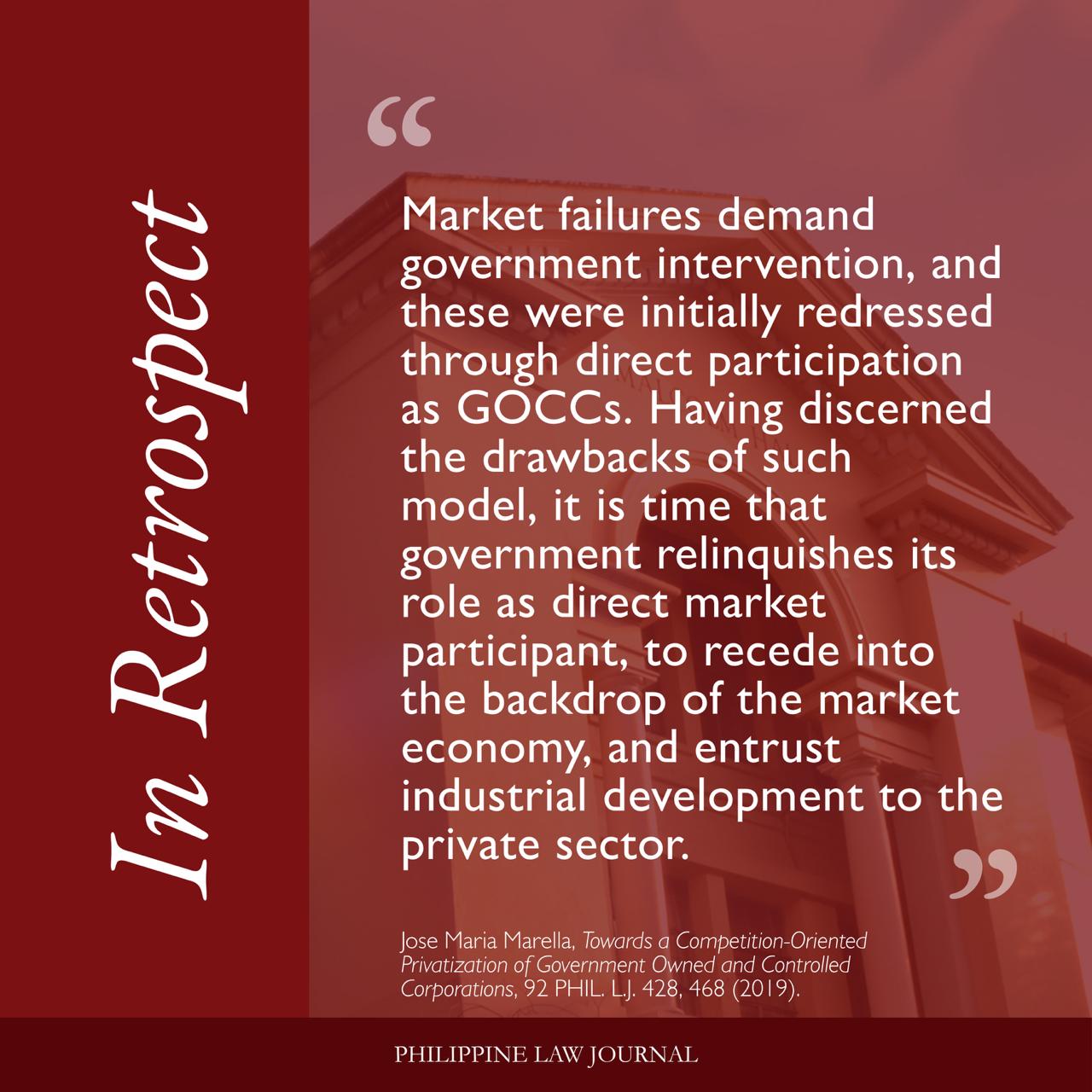
Marella’s discussion of Article XII, Section 19 of the Constitution, that “[n]o combinations in restraint of trade or unfair competition shall be allowed,” centered around the privatization of GOCCs in the interest of preventing government-induced competitive distortions.[7] Marella posits that the State’s responsibility to intervene in the market stems from the inevitability of market failures such as monopolies,[8] born from the private sector’s inability to regulate itself. The article forwards that the State’s responsibility is further amplified when the competitive distortion comes from the government itself.
Marella roots his argument in the principle of competitive neutrality, which requires a regulatory framework where public and private enterprises face the same set of rules, ensuring no market participant gains an unfair advantage simply through contact with the State.[9] To systematically address this, he proposes a three-step methodology to determine which GOCC functions should be privatized: the presence of market failures, market contestability, and the viability of alternative government interventions.[10]
Furthermore, Marella advocates for structural mechanisms during the privatization process itself. He suggests prioritizing share auctions over asset sales to democratize ownership,[11] imposing restrictive covenants to prevent immediate alienations to industry incumbents,[12] and mandating institutional coordination between the Governance Commission for GOCCs (GCG) and the Philippine Competition Commission (PCC).[13]
Marella’s warnings are particularly prescient when viewed against the historical backdrop of Philippine privatization efforts, such as the privatization of power generation through the Electric Power Industry Reform Act of 2001 (“EPIRA”).[14] The EPIRA was primarily used as a tool to resolve the State’s immediate fiscal crisis and structural inefficiencies following the National Power Corporation’s massive accumulation of liabilities.[15] However, the liberalization of the pricing of commodities risked the creation of new monopolistic strategies when regulation is not properly delineated or enforced.[16]
Nicolo Paolo P. Ludovice & Laurence L. Delina in their article, From Concessions to Competition: A Journey Through the Evolution of the Philippine Electric Grid System, illustrate that privatization under the EPIRA compromised the system of fragmentation between sectors and created subsequent overlap of public and private functions. While the operation of the transmission system was entrusted to the privatized National Grid Corporation of the Philippines (“NGCP”), the Department of Energy (DOE) retained its policy-making and regulatory capacities.[17]
This is significant as the energy sector, as a public utility, is naturally prone to monopoly.[18] In an industry that requires large capital investment, with high barriers to entry, it is difficult to assume that privatization will create competition.[19] When GOCCs withdraw from direct participation without any clear boundaries as to regulation or operation, the public monopoly may simply be replaced by a private one.[20] The EPIRA framework reflects this risk in its accountability issues. Ludovice and Delina note that the roles and responsibilities of the DOE and NGCP were occasionally “nebulous,” leading to functional overlaps in matters like transmission planning, investor relations, and contractual agreements with power plants.[21] This tension between private corporations and their regulators also cause concerns in utility and affordability.[22]
While bodies such as the Energy Regulatory Commission (ERC) have regulatory powers over pricing of electricity, private corporations can still manipulate supply to increase profits. This fragmentation can cause private actors to affect supply, justify power interruptions as maintenance procedures, and influence prices within a formally liberalized market, causing gaps in accountability measures by the public sector and mechanisms by the framework.[23] Thus, continuing State participation in the energy sector is still important, as this allows government entities to serve a stabilizing and countervailing function by helping ensure that energy policy remains directed toward public welfare rather than merely bolstering private profit.[24]
In this light, Ludovice and Delina’s work extends Marella’s thesis by revealing the gap between privatization policy and the ever-present reality of market failures which arise when such policies are operationalized. While Marella emphasizes the importance of ex ante safeguards to avoid falling into anti-competitive market structures, Ludovice demonstrates that accountability measures must extend until implementation, and that the interplay between private and public actors defines the success of privatization efforts.
The competitive distortion which may exist post-privatization is well illustrated in El Cid Butuyan et al.’s analysis of the PCC’s amicus curiae brief in the case of Philippine Contractors Accreditation Board (“PCAB”) v. Manila Water Co., Inc. (“MWCI”).[25] In the case, PCAB denied the accreditation of MWCI’s foreign contractors, which served as a severe deterrent to the entry of foreign contractors in the national construction industry. The PCC argued that such an action is a government distortion of fair competition and therefore violative of the Constitution.[26] The argument against the PCC was that construction is already an industry with high barriers to entry and that the substantial difference between foreign and local contractors is sufficient to burden the latter with more stringent conditions.[27] However, the PCC successfully invoked the case of Tatad v. Secretary of the Department of Energy, where despite existing high barriers in the oil industry, the Court still struck down measures to make the barriers even higher, as it would only serve the existing oligopoly.[28]
In the same manner, the Court struck down the PCAB’s restriction against foreign contractors and was receptive of the PCC’s use of economic evidence to illustrate how the restriction’s anti-competitive nature would serve to seriously deter foreign entry and investment, which would be detrimental to the industry as a whole.[29]
Butuyan et al. highlighted the PCC’s use of statistical socio-economic data to illustrate the consequences of PCAB’s regulation, which in turn was a strategy taken from the “Brandeis Brief” strategy pioneered in the United States.[30] Evident is the fact that in order to expose the “real impact of the licensing scheme and its far-reaching consequences,”[31] and to open up the discussion on how the PCAB created a substantial distinction, the PCC relied on data to back up their warnings. Butuyan emphasized that the PCC’s successful presentation of data proves that litigation may be an effective avenue in the pursuit of competition advocacy. Adopting such a mode needs the PCC’s method of argumentation, one grounded in real-world analysis, as was elucidated by Gwen Grecia-De Vera, “competition policy involves economic analysis embedded within a legal framework and the necessity of being able to convey the economic analysis in a way that would be understandable from the legal perspective.”[32] Butuyan et al. illustrates how regulatory bodies may leverage empirical economic data to provide effective post-hoc enforcement measures against possible abuse of dominance by privatized industries.
While Marella provides a framework for the State’s strategic withdrawal from the market through competition-oriented privatization, the article Maharlika Investment Fund: Still Beyond Repair by Ma. Joy V. Abrenica, et al. analyzes the Maharlika Investment Fund (“MIF”) bill, which has now passed into law.[33] Abrenica et al. expose complications that arise from its violations of fundamental principles of economics and finance that pose serious risks to the economy and the public sector.[34] This analysis adds to Marella’s theory on the risks of the State acting as a “perennial interventionist” by illustrating the economic risks posed by the MIF which seeks to intervene and assist in development efforts, but is instead counterproductive to existing development funding mechanisms in the government.
Abrenica et al.’s paper illustrates the systemic “ill” in the government’s inability to demarcate between its roles as a regulator and a competitor, a condition termed by Marella as “schizophrenia,”[35] through the MIF’s double-bottom line objective, in which it attempts to reap both commercial and developmental returns. Abrenica et al. argue that this dual mandate disorients its goals, acting contrary to the principle that a sovereign wealth fund (“SWF”) should have clear goals that serve to delimit its allowable investments and activities, and set reasonable expectations and metrics of success.[36] Lacking a clear goal, the MIF would suffer several economic consequences, in that it is incapable of determining financial or economic returns, nor analyzing whether its investments and activities are sustainable.[37] The consequences forwarded by the article reflects Marella’s warning that such institutional blurring leads to conflicts of interest and market distortions.
Marella’s framework for privatization requires testing for market failure and determining whether a function is best carried out by the private sector. Abrenica et al.’s work reflects the consequences of failure under this framework by showing that the MIF lacks “additionality”, which is a crucial prerequisite for setting up sovereign development funds. “Additionality,” according to Abrenica et al., requires that new development funds must produce economic, environmental, and social returns equivalent to those that would happen without it, essentially adding to the capabilities of the government with its current budget process and other agencies, without rendering redundant any of its functions.[38]
These articles show the possible pitfalls of privatization which fails to account for the unique characteristics of monopolistic industries turned over to private operations. Ultimately, effective privatization requires the State to solidify its role as a regulator of the industry, as opposed to the mere streamlining of State-operated industries. With the rise of the privatization of critical infrastructure, and the amplification of the Build-Operate-Transfer framework, the State must evaluate and internalize the unique socio-economic factors to ensure that the practices of private operators align with the goals of the nation.
This In Retrospect piece was prepared by Patricia Isabel Bayhon, Jasper John Desamito, Raevien Pintang, and Israel Rabbi Salvador under the supervision of Aaron Reiel Chan, Vol. 99, and with contributions from Josemaria Sebastian, Chair, Vol. 99, and Benedict Casiño, Vice Chair, Vol. 99.
In Retrospect is a series of thought pieces revisiting past Journal articles in light of recent developments in current affairs or related literature. They are written by Philippine Law Journal interns, with guidance from the Editorial Board.
[1] John Eric Mendoza, SMC wins bid for P170.6-billion Naia rehabilitation project, Inquirer.net, Feb. 16, 2004, at https://business.inquirer.net/445738/smc-wins-bid-for-naia-rehabilitation-project.
[2] Manila Int’l. Airport Auth. v. Ct. of Appeals, 528 Phil. 181, 213 (2006). The Manila Int’l. Airport Auth. (“MIAA”) is classified as a government instrumentality, not a government-owned or -controlled corporation (“GOCC”).
[3] Mendoza, supra note 1.
[4] Jose Maria Marella, Towards a Competition-Oriented Privatization of Government Owned and Controlled Corporations, 92 Phil. L.J. 428 (2019).
[5] Id. at 430.
[6] Id.
[7] Id. at 446–47.
[8] Id. at 451–52. “Market failure is the first and foremost justification for government intervention. It is ‘the inability of a market economy to reach certain desirable outcomes in resource use.’ Failures occur because the private sector cannot be relied upon to produce public goods, like information; because some firms exert monopoly power; when the market is riddled with externalities, such as pollution; or information asymmetries abound certain industries, as in the banking sector.”
[9] Id. at 437.
[10] See id. at 449–54.
[11] Id. at 459.
[12] Id. at 462–64.
[13] Id. at 464–66.
[14] Rep. Act No. 9136 (2001). Electric Power Industry Reform Act of 2001.
[15] Nicolo Paolo Ludovice & Laurence Delina, From Concessions to Competition: A Journey Through the Evolution of the Philippine Electric Grid System, 1892–2021, 36 Electricity J. 1, 3–4 (2023), at https://doi.org/10.1016/j.tej.2023.107319.
[16] Id. at 4–5.
[17] Id. at 4.
[18] Joseph Emmanuel Angeles, Revisiting Republic v. Meralco, the Public Utility Definition, and the Reasonable Rate of Return, 92 Phil. L.J. 214, 216–17 (2019).
[19] Ludovice & Delina, supra note 15, at 5.
[20] Id. at 5.
[21] Id. at 4.
[22] Id.
[23] Id. at 4–5.
[24] Id. at 1, 4–5.
[25] 872 Phil. 577 (2020).
[26] El Cid Butuyan, Graciela Base, & Jose Maria Marella, Sowing the Seeds for Strategic Competition Litigation: The Philippine Competition Commission’s Amicus Curiae Brief in PCAB v. MWCI, 47 IBP J. 84, 87 (2023).
[27] Id. at 93–94.
[28] Id. at 94.
[29] Id.
[30] Id. at 88.
[31] Id. at 92.
[32] Id. at 96 n.21.
[33] Rep. Act No. 11954 (2023). Maharlika Investment Fund Act of 2023.
[34] Ma. Joy V. Abrenica et al., Maharlika Investment Fund: Still Beyond Repair 1 (UP School of Econ., Discussion Paper No. 2023-02, 2023).
[35] Marella, supra note 4, at 429.
[36] Abrenica et al., supra note 34, at 4.
[37] Id. at 8.
[38] Id. at 6.