Addressing Plastic Pollution in the 2026 ASEAN Summit
Plastic pollution has emerged as a transboundary concern,[1] indubitably positioning the Association of Southeast Asian Nations (ASEAN) to assume a vital role in identifying potential domains for state intervention. The matter bears particular significance due to the timing. The Philippines, Chair of the 2026 ASEAN Summit, remains one of the largest contributors to marine plastic pollution, leaking 0.3 million metric tons of plastic waste into the oceans every year.[2] Along with other ASEAN Member States—namely, Malaysia and Indonesia—the Philippines has the highest proportion of generated plastic waste infiltrating marine ecosystems.[3] Plastic waste is predicted to outnumber the fish in the ocean by 2050, destroying ecosystems around the world.[4] With the theme for this year’s Summit being “Navigating the Future, Together,”[5] all eyes are on the ASEAN to decisively preclude a future of environmental degradation caused by plastic pollution.
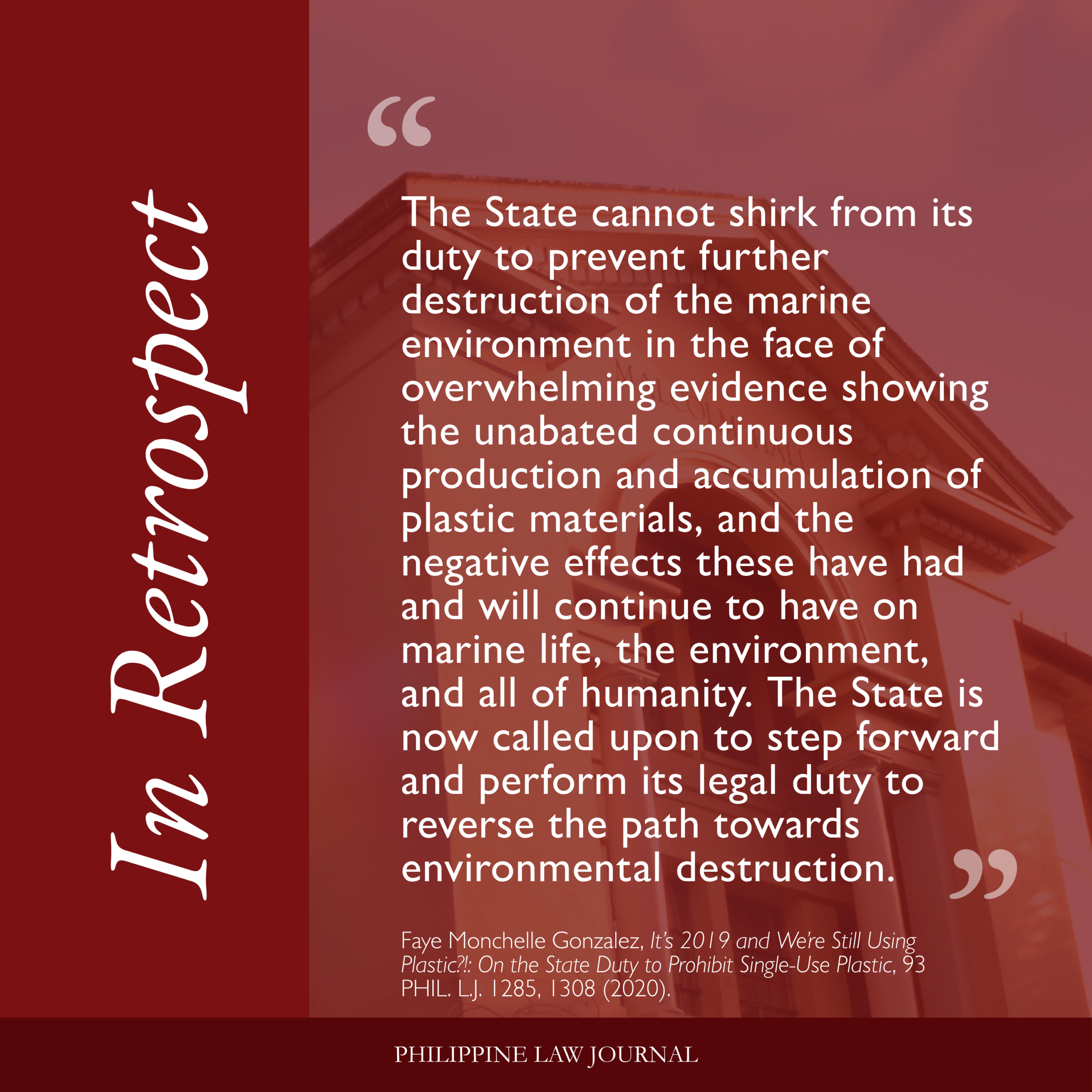
Faye Monchelle O. Gonzalez offers one approach to mitigating this problem in her Philippine Law Journal Note, It’s 2019 and We’re Still Using Plastic?!: On the State Duty to Prohibit Single-Use Plastic.[6] Gonzalez calls upon the State to fulfill its duty to ensure the right to a balanced and healthful ecology by banning the use and production of single-use plastics (“SUPs”) within the Philippines. The said right is expressly mandated by Article II, Section 16 of the 1987 Constitution, which the Supreme Court interpreted in Oposa v. Factoran[7] to imply a “correlative duty to refrain from impairing the environment.”[8]
Gonzalez argues that this duty would be most effectively fulfilled through the classification of single-use plastics as non-environmentally acceptable material under Republic Act (R.A.) No. 9003, or the “Ecological Solid Waste Management Act” (“ESWMA”).[9] R.A. No. 9003 empowers the National Solid Waste Management Commission (“NSWMC”) to “formulate and update a list of non-environmentally acceptable materials”[10] which are prohibited as packaging.[11] By exercising this power and categorizing single-use plastics as non-environmentally acceptable packaging, the national government, through the NSWMC, could disincentivize businesses from using such packaging for their products. Gonzalez emphasizes that changing the behaviors of businesses is crucial, as “the source of the waste must be dealt with directly,”[12] in accordance with the state policy of “solid waste avoidance and volume reduction through source reduction and waste minimization measures.”[13]
Since the publication of Gonzalez’s Note, the Philippines has taken some steps to reduce the presence of plastics throughout the country, although it has yet to achieve a nationwide ban. In 2020, the NSWMC issued a resolution under which certain plastic utensils were considered as “unnecessary single-use plastics” to be banned in the offices of the national government and local government units, as well as all other government-controlled offices.[14] However, the NSWMC has yet to issue any resolution extending the scope of the ban to private offices, institutions, and spaces. In 2021, House Bill No. 9147, which sought to phase out SUP products,[15] was filed in and eventually approved by the House of Representatives. However, it remained untouched until it was refiled in 2025.[16] This recent development could signify renewed legislative interest in the regulation of SUPs, although any promise of immediate or, at least consistent, change is tempered by the preceding years-long inaction on the issue.
Nonetheless, even if the Philippines were to enact a nationwide ban on SUPs, any national effort, to have a significant impact on the mitigation of transboundary harm from plastic pollution, would require regional collaboration. Collaboration, however, would be meaningless without transparency and accountability. Ria Wierma Putri and Febryani Sabatira, in their article The Paradox of ASEAN Way in Marine Pollution: The Challenge of Compliance Among Member States, suggest that the current problems faced by the ASEAN require a transition from “consensual decision-making, non-confrontational dispute settlement, respect for sovereignty, and non-intervention principles,” or the so-called “ASEAN Way,” “towards a rules-based regime and deeper regional integration.”[17] Specifically, they attribute the absence of a regionally binding instrument on plastic pollution, specifically in marine areas, to a rigid adherence to the ASEAN Way.[18] Thus, although many of its Member States, such as the Philippines, have established ambitious national environmental goals, the ASEAN has instituted only soft-law instruments, such as the Bangkok Declaration on Combating Marine Debris and the ASEAN Regional Action Plan for Combating Marine Debris. That said, while “grounded in political commitment,” they are ultimately toothless.[19]
Putri and Sabatira characterize the ASEAN Way as a regional preference for hard law in economic cooperation and for soft law in non-economic policies such as environmental protection.[20] Consequently, ASEAN’s environmental initiatives on marine plastic pollution typically rely on the voluntary participation of and flexible agreements among Member States. These result in an institutional infrastructure that lacks robust enforcement mechanisms or centralized oversight. Overall, the ASEAN Way “allows national governments to avoid committing to joint tasks that they may find administratively demanding, politically challenging (especially if they conflict with dominant national interests), or not a top priority amid their national agendas,”[21] such that the action of one Member State could ultimately be negated by the inaction of another.
To effectively mitigate marine plastic pollution, Putri and Sabatira propose a framework centered on compliance monitoring.[22] The proposed framework requires the ASEAN to enhance its technical and administrative capacity for monitoring compliance with regional commitments. It also requires the adoption of formal rules of procedure for such monitoring and for addressing non-compliance.[23] By transitioning from purely voluntary cooperation to a system of incentivized adherence and institutionalized oversight, Member States can bridge the divide between domestic legislation and regional environmental sustainability.
However, the solution to marine plastic pollution does not stop with the creation, or even the enforcement, of national laws and regional instruments. A more sustainable strategy would also require the empowerment of persons most adversely affected by the problem, such as “indigenous populations with traditional cultures based on the seas,”[24] also known as “sea peoples.” In his article, Sea Peoples & Marine Plastic Pollution in Southeast Asia: An International Human Rights Approach in Support of Indigenous Rights to Environment, Jonathan Liljeblad proposes precisely the adoption of “bottom-up” approaches to marine plastic pollution, or those “encompassing contributions of non-state stakeholders from local communities,” to complement “top-down” approaches “in the form of state-directed policies.”[25] Liljeblad focuses on sea peoples in Southeast Asia, as “they suffer from elevated levels of vulnerability” to marine plastic pollution, given their lifestyle, location, and lack of legal personality.[26]
Similar to how Gonzalez criticizes the failure of national and local legislation through lack of commitment, inefficiency, and inability to address the problem at the root by going after actual manufacturers of plastic waste, Liljeblad discusses how the top-down approach fails in the context of sea peoples who seek to assert their rights but often find themselves in “unequal contests with state, societal, and economic interests who enjoy relatively greater capacity to exercise legal strategies.”[27] Instead, Liljeblad advocates for the application of international human rights (“IHR”) law as a source of sea peoples’ procedural and substantive rights and legal personality.[28]
According to Liljebad, IHR law presents a feasible alternative to the “state-centric disposition”[29] posed by international environmental (“IE”) law. Whereas IE law gives states a wide latitude of discretion in terms of providing legal remedies for non-state actors, IHR law imposes a duty on states to protect those under its jurisdiction. Furthermore, IHR law provides for the right of self-determination, such that the State is mandated to grant indigenous groups the “power to decide their own status,” although it does not necessarily recognize their existence. This is unlike IE law, which leaves the recognition of indigenous groups solely to the will of the state.[30]
Liljebad maps out a case for sea peoples to ground, exercise, and assert their rights under IHR law, as expressed primarily in the International Convention for Civil and Political Rights (“ICCPR”), the International Convention for Economic, Social, and Cultural Rights (“ICECSR”), and the Declaration on the Rights of Indigenous Peoples (“DRIP”). First, in terms of substantive rights, marine plastic pollution directly harms sea peoples’ survival and subsistence. These are linked to their rights to life and to health,[31] of economic self-reliance and development,[32] and even to religion and spirituality,[33] among others. Second, the right to participate in decision-making, which is also implied from the provisions on rights which require consent of indigenous groups, necessarily includes the right to have access to legal remedies.[34] Third, and most importantly, through the exercise of the right of self-determination, indigenous groups can become active agents in identifying themselves as “peoples” who can hold and enforce rights, more than mere passive recipients of state-granted privileges.[35] Thus, under IHR law, indigenous groups, including sea peoples, could contribute to actualizing the policies which underlie national laws and regional instruments.
Its Chairship of the 2026 ASEAN places the Philippines at a legal crossroads. The threat of environmental decline caused by plastic pollution is no longer imminent but fully present. As such, the Philippines must now utilize its unique position to promote a “balanced and healthful ecology” by ensuring the strict compliance of its neighbors with a regionally binding agreement. If the ASEAN is to mitigate rapid environmental degradation, then its Member States must ensure not only accountability among themselves, but also accessibility for non-state actors.
This In Retrospect piece was prepared by Marco Amora, Camyl Camba, Samantha Carpio, and Ysabel Vidor under the supervision of Jess Cuadro, Vol. 99, and with contributions from Josemaria Sebastian, Chair, Vol. 99, and Benedict Casiño, Vice Chair, Vol. 99.
In Retrospect is a series of thought pieces revisiting past Journal articles in light of recent developments in current affairs or related literature. They are written by Philippine Law Journal interns, with guidance from the Editorial Board.
[1] Rizky Anggia Putri & Maula Hudaya, The Establishment of ASEAN Framework of Action on Marine Debris: The Role of Shared Knowledge, 24 Glob.: Jurnal Politik Internasional 63, 64 (2022).
[2] World Bank, Addressing a National Challenge: How the Philippines is Strengthening Sustainable Plastic Waste Management with Support from the World Bank Group 7 (2025), at https://hdl.handle.net/10986/44234.
[3] Id.
[4] Putri & Hudaya supra note 1, at 63.
[5] ASEAN 2026: About the ASEAN 2026 Philippine Chairship, ASEAN 2026 Website, at https://asean2026.gov.ph/about.
[6] Faye Monchelle Gonzalez It’s 2019 and We’re Still Using Plastic?!: On the State Duty to Prohibit Single-Use Plastic, 93 Phil. L.J. 1285 (2020).
[7] [Hereinafter “Oposa”], G.R. No. 101083, 224 SCRA 792, July 30, 1993.
[8] Id. at 805.
[9] Gonzales, supra note 6, at 1299.
[10] Id. at 1301; Rep. Act. No. 9003 [hereinafter “ESWMA”] (2001), § 5(i). Ecological Solid Waste Management Act of 2000.
[11] § 30.
[12] Gonzalez, supra note 6, at 1302.
[13] ESWMA, § 2(c).
[14] National Solid Waste Management Commission (NSWMC) Res. No. 1363 (2020). Resolution Directing the Department of Environment and Natural Resources (DENR) to Prepare and Implement the Banning of the Use of Unnecessary Single-Use Plastics by National Government Agencies (NGAs), Local Government Units (LGUs) Offices and All Other Government Controlled Offices.
[15] H. No. 9147, 18th Cong., 3rd Sess. (2021). Single-Use Plastic Products Regulation Bill.
[16] H. No. 6853, 20th Cong., 1st Sess. (2025). Single-Use Plastic Products Regulation Bill.
[17] Ria Wierma Putri & Febryani Sabatira, The Paradox of the ASEAN Way in Marine Plastic Pollution: The Challenge of Compliance Among Member States, 9 J. Liberty & Int’l Aff. 248, 249 (2023).
[18] Id. at 255.
[19] Id. at 254.
[20] Id. at 255.
[21] Id.
[22] Id. at 256.
[23] Id. at 256–57.
[24] Jonathan Liljeblad, Sea Peoples & Marine Plastic Pollution in Southeast Asia: An International Human Rights Approach in Support of Indigenous Rights to Environment, 27 UCLA J. Int’l L. & Foreign Aff. 59, 61 (2024).
[25] Id. at 67.
[26] Id. at 61.
[27] Id. at 64.
[28] Id. at 76–77.
[29] Id. at 71.
[30] Id. at 73.
[31] Id. at 84.
[32] Id. at 85.
[33] Id.
[34] Id. at 87.
[35] Id. at 94.