
Evolving Needs, Two Decades Since the Anti-VAWC Act
Twenty-one years have passed since the enactment of Republic Act No. 9262, or the Anti-Violence Against Women and their Children Act (“Anti-VAWC Act”).[1] The legislation is the product of decades of advocacy[2] to protect women and their children from the various forms of violence committed by their male partners. The Anti-VAWC Act corrected the shortcomings of People v. Genosa,[3] which had framed domestic abuse through the concept of Battered Woman Syndrome (“BWS”), an approach that tended to pathologize women for being victims of violence rather than recognizing the pervasive and systemic nature of domestic abuse.
Since the Act’s promulgation, however, newer forms of violence against women have emerged. Violence is no longer confined to private or intimate settings,[4] but now manifests in institutional and social contexts and across sexual orientation, gender identity, and expression.
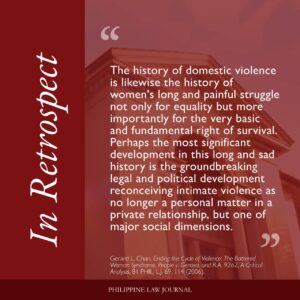
Throughout much of the 20th century, domestic violence was trivialized as a “private matter,” which prevented intervention[5] and left abused women largely invisible under the law. This long-standing institutional neglect formed the backdrop of Genosa, and later, the Anti-VAWC Act—both of which attempted to confront the failures of that tradition.
In this context, the Philippine Law Journal article, Ending the Cycle of Violence: The Battered Woman Syndrome, People v. Genosa, and RA 9262, A Critical Analysis, written by Gerard L. Chan, examines how Genosa and the Anti-VAWC Act transformed legal responses to battered women. Chan argues that these developments reflect an important shift toward recognizing battered women’s experiences in law.[6] Genosa also reveals doctrinal inconsistencies, particularly the Court’s selective application of BWS[7] and its tendency to treat battered women as suffering from a condition rather than understanding their responses within the dynamics of abuse.[8] He explains that Genosa and the statute both attempt to reconcile BWS with traditional self-defense, while underscoring the need for a clearer understanding of the syndrome’s conceptual basis, limits, and legal significance.[9]
Chan grounds this discussion in Dr. Lenore Walker’s definition of BWS as a pattern of coercive abuse marked by at least two acute battering episodes[10] and expressed through a cycle of violence,[11] which the Court adopted[12] but applied inconsistently.[13] He adds that BWS explains how fear, economic dependence, or learned helplessness,[14] among others, can trap a woman in escalating abuse until she believes she must act to survive.[15] For Chan, these dynamics show that BWS functions as a justification based on a woman’s perception of danger rather than as an excuse.[16]
In Genosa, despite years of battering and documented hospitalizations, the Court concluded that the defense had not proven all phases of the cycle. It merely considered a single incident, i.e., the events preceding the husband’s killing, and disregarded the numerous incidents of batteries and injuries.[17] The Court then applied traditional self-defense rules and evaluated the situation through the lens of an “ordinary ‘reasonable’ person,” which Chan notes is inappropriate for someone trapped in a continuing cycle of violence.[18] Yet, the Court acknowledged that a battered woman should not be judged by that standard. Chan highlights this contradiction, noting that requiring a battered woman to wait for a clear deadly attack before acting would amount to “sentencing her to murder by installment.”[19]
Chan further observes that the Court’s description of the respondent, Marivic, as “suffering” from BWS[20] reflects a view of the battered woman as diseased, which treats the syndrome as an excuse rather than a justification.[21] This view was reinforced when the Court granted mitigating circumstances under the Revised Penal Code for an “illness” diminishing willpower, thereby pathologizing her actions instead of contextualizing them.[22]
The Anti-VAWC Act defined BWS,[23] created protection orders,[24] increased penalties,[25] and provided that a woman “suffering from battered woman syndrome” incurs no criminal and civil liability, even in the absence of the traditional elements of self-defense.[26] Chan notes that the statute’s continued use of the term “suffering” again suggests pathology and risks reinforcing the notion that battered women are afflicted,[27] rather than responding rationally to cumulative abuse.[28]
Taken together, Genosa and the Anti-VAWC Act exposed the widespread nature of domestic violence[29] and reframed intimate violence as a matter of broader social concern.[30] Chan describes these developments as steps in the right direction and emphasizes that domestic violence is not simply a women’s issue, but a family and community concern.[31]
While Chan provides the doctrinal foundation for understanding institutional responses to domestic abuse, Patrizia Adeline A. Lucindo’s article, Anti-SLAPP and Pro-Women: A Study on the Applicability of the Concept of Strategic Lawsuit Against Public Participation to Cases Involving Violence Against Women and Their Children,[32] expands the discussion by examining how legal institutions are weaponized to suppress actions filed against domestic abusers. Lucindo explores how abusers use Strategic Lawsuits Against Public Participation (“SLAPP”)[33] to silence women who speak out against abuse, employing litigation as retaliation. SLAPP refers to a baseless civil suit filed to intimidate individuals for exercising their right to speak on matters of public concern by burdening them with legal costs, harassment, and prolonged litigation.[34] In the Philippines, SLAPP was first introduced in environmental cases under the Rules of Procedure for Environmental Cases (“RPEC”) and is recognized only in that context. In Mercado v. Lopena,[35] the Supreme Court was asked to apply SLAPP more broadly, but the case was dismissed on procedural grounds. Nonetheless, it opened the possibility that SLAPP could be relevant to VAWC cases.[36]
Lucindo argues that SLAPP suits against women who suffered abuse should be recognized as violations of the Anti-VAWC Act. Such suits constitute psychological[37] and economic abuse[38] because they cause undue mental and emotional anguish, while imposing significant financial burdens.[39] The threat of legal action for speaking out about one’s abuse deepens the trauma experienced by women and produces a chilling effect on free speech.[40] The article recommends amending the Anti-VAWC Act to explicitly include SLAPP suits as forms of psychological and economic abuse.
Lucindo further proposes mechanisms for the swift dismissal[41] of SLAPP suits and the introduction of “SLAPP-Back” counterclaims,[42] fostering a legal environment in which women are protected rather than further victimized by litigation.[43] These reforms would help break cycles of retaliation, reduce women’s fear of speaking out, and diminish the perceived need to resort to lethal force to escape abusive partners. As she writes, “[a]s acts of abuse and violence become more nuanced and sophisticated, so too should our laws and rules. Therefore, the concept of SLAPP should be made applicable to VAWC-related cases.”[44] Recognizing SLAPP as a defense would give Filipino women another layer of protection addressing forms of retaliatory legal harm.
Building on the increased protection for women from domestic abuse discussed by Chan, Jose Ryan S. Pelongco’s article, In a Class of Their Own: A Review of Quasi-Suspect Classes in Philippine Jurisprudence and the Direct Effect of Case Law in Spurring Legislative Enactments, examines how the Supreme Court, by recognizing certain marginalized, discriminated, or oppressed (“MDO”) groups such as women, children, and Indigenous Peoples as quasi-suspect classes, exercises judicial authority in ways that extend beyond resolving legal disputes. According to Pelongco, the Court’s pronouncements not only clarify the scope of constitutional protection but also serve as a call to Congress, prompting lawmakers to enact statutes that incorporate these constitutional protections into the broader legal framework.[45]
Pelongco engages with Chan’s analysis by examining Genosa and the subsequent enactment of the Anti-VAWC Act as a concrete example of judicial influence on legislation. While Chan examines the Court’s difficulty in fitting BWS within the traditional self-defense framework and the legislation that filled that doctrinal gap,[46] Pelongco extends this by showing that the Court’s explicit acknowledgment in Genosa that only Congress could amend the Revised Penal Code to properly address BWS triggered a swift legislative response. This development, embodied in Section 26 of the Anti-VAWC Act, demonstrates how the Court’s inability to directly grant full protections to abused children and battered women nonetheless prompted Congress to act, since the Court’s persistent pronouncements ultimately drove the creation of legislative remedies to address injustice.[47]
Pelongco also argues that the Anti-VAWC Act reflects a deeper constitutional commitment to addressing structural and institutional gender-based harm by recognizing women as a quasi-suspect class deserving heightened protection.[48] In this respect, the statute functions not only as a doctrinal correction responding to BWS but also as an acknowledgment of entrenched gendered power imbalances, which shifts the discourse from a narrow criminal law question to a constitutional imperative of ensuring substantive equality for vulnerable groups. He notes that judicial declarations concerning marginalized classes often act as persuasive signals that prompt legislative responses, ultimately embedding these protections into Philippine law.[49]
As violence against women continues to evolve, now including institutional, social, and SOGIE-based forms, there is a growing need to expand legal protections to gender minority groups who experience similar vulnerabilities but remain unrecognized. Yves Peter Carlo D. Medina’s work, Honor Her Name: Recognizing Violence Committed Against Transgender Women in a Dating or Sexual Relationship as Violence Against Women and Their Children Under R.A. 9262, highlights the doctrinal exclusion of transgender women from the reach of the Anti-VAWC Act.[50]
Medina notes that Philippine jurisprudence recognizes only biological sex, as seen in Silverio v. Republic,[51] where the Court held that sex refers exclusively to biological traits assigned at birth—not to post-operative changes. The closest jurisprudential recognition of transgender persons in the Philippines appears in Republic v. Cagandahan, [52] but the Court in this case only considered intersex individuals. As a result, transgender women, despite being similarly vulnerable to domestic abuse and hate crimes, fall outside the protection of the Anti-VAWC Act. To illustrate the gravity of this doctrinal exclusion, Medina cites several cases of violence against transgender women, including the killings of Jennifer Laude in 2014, Jessa Remiendo in 2019, and Donna Nierra in 2020.[53]
Medina argues that although transgender women and cisgender women both experience domestic violence and hate crimes, the legal framework fails to accommodate transgender women because protection under current law is anchored on biological sex rather than gender identity.[54] According to the Commission on Human Rights (CHR), there is minimal information regarding domestic violence and discrimination against transgender women.[55] Medina provides two recommendations to extend protection to transgender women within the existing legal framework. The first is an amendment to the CHR’s data collection mechanisms to include violence committed against transgender women.[56] The second is an amendment to the Anti-VAWC Act to include, within its definition of “woman,” persons who identify as women regardless of sex assigned at birth.[57] This may be supported through an affidavit declaring that the individual identifies as a woman.[58]
The works of Chan, Lucindo, Pelongco, and Medina show that violence against women appears in doctrinal, institutional, structural, and gender-based forms that extend beyond what the original Anti-VAWC Act contemplated. The judiciary’s approach to doctrines such as BWS, together with its recognition of women as a quasi-suspect class, reflects an evolving legal landscape, while legislative action continues to adapt to emerging needs. These developments underscore the importance of expanding the Act’s protections to ensure that legal protections remain responsive to contemporary forms of abuse and continue to safeguard the rights and welfare of women.
This In Retrospect piece was prepared by Joey Junio, Quiel Endaya, Au Ferreras, Seij Ogata, and Karl Trenchera, under the supervision of Aaron Chan, Vol. 99, and with contributions from Josemaria Sebastian, Chair, and Benedict Casiño, Vice Chair, Vol. 99.
In Retrospect is a series of thought pieces revisiting past Journal articles in light of recent developments in current affairs or related literature. They are written by Philippine Law Journal interns, with guidance from the Editorial Board.
[1] Rep. Act. No. 9262 [hereinafter “Anti-VAWC Act”] (2004). Anti-Violence Against Women and Their Children Act of 2004.
[2] Ma. Rowena Amelia V. Guanzon, Legal and Conceptual Framework of Battered Woman Syndrome as a Defense, 86 Phil. L. J. 123, 124 (2011). See also Ma. Rowena Amelia V. Guanzon & Marie Arcie Anne M. Sercado, Issues and Problems in the Enforcement of the Anti-Violence Against Women and Their Children Act of 2004, 83 Phil. L.J. 312 (2008).
[3] [Hereinafter “Genosa”], G.R. No. 135981, 419 SCRA 537, Jan. 15, 2004.
[4] Gerard L. Chan, Ending the Cycle of Violence: The Battered Woman Syndrome, People v. Genosa, and RA 9262, A Critical Analysis, 81 Phil. L.J. 69, 70–71 (2006).
[5] Id. at 74.
[6] Chan, supra note 4, at 114.
[7] Id. at 99.
[8] Id. at 106.
[9] Id. at 115.
[10] Id. at 76.
[11] Id. at 78. The cycle of violence has three phases: (1) a tension-building phase, marked by minor but escalating abuse; (2) an acute battering phase, when violence becomes severe and most injuries occur; and (3) a loving–contrition phase, a temporary calm that may renew the victim’s hope for change. In more severe relationships, the third phase may disappear. The cycle then repeats, with assaults becoming increasingly frequent and intense.
[12] Id. at 96.
[13] Id. at 99–100.
[14] Id. at 77, 80. “Learned helplessness” describes the belief that “no response, decision or course of action will ever alter the present situation.”
[15] Id. at 82.
[16] Id. at 93.
[17] Id. at 97.
[18] Id. at 98–99.
[19] Id. at 99.
[20] Id. at 103.
[21] Id.
[22] Id. at 106.
[23] Anti-VAWC Act, § 3(c).
[24] §§ 8–17. See Chan, supra note 4, at 109.
[25] Anti-VAWC Act, § 6. See Chan, supra note 4, at 110.
[26] Chan, supra note 4, at 112.
[27] Id.
[28] Id. at 105.
[29] Id. at 115.
[30] Id. at 114–15.
[31] Id. at 115.
[32] Patrizia Adeline A. Lucindo, Anti-SLAPP and Pro-Women: A Study on the Applicability of the Concept of Strategic Lawsuit against Public Participation to Cases Involving Violence against Women and Their Children, 95 Phil. L.J. 582 (2022).
[33] Penelope Canan & George Pring, Strategic Lawsuits against Public Participation, 35 Soc. Probs. 506, 506 (1988).
[34] Lucindo, supra note 34, at 588–89.
[35] G.R. No. 230170, 865 SCRA 509, June 6, 2018.
[36] Lucindo, supra note 34, at 596.
[37] Id. at 597.
[38] Id. at 599.
[39] Id. at 599–600.
[40] Id. at 590.
[41] Id. at 601.
[42] Id. at 602.
[43] Id. at 603–04.
[44] Id. at 603.
[45] Jose Ryan S. Pelongco, In a Class of Their Own: A Review of Quasi-Suspect Classes in Philippine Jurisprudence and the Direct Effect of Case Law in Spurring Legislative Enactments, 65 Ateneo L.J. 308, 343 (2020).
[46] Chan, supra note 4, at 115.
[47] Pelongco, supra note 48, at 339.
[48] Id. at 309–11.
[49] Id. at 343.
[50] Yves Peter Carlo D. Medina, Honor Her Name: Recognizing Violence Committed Against Transgender Women in a Dating or Sexual Relationship as Violence Against Women and Their Children Under R.A. 9262, 68 Ateneo L.J. 853. (2024).
[51] G.R. No. 174689, 537 SCRA 373, Oct. 19, 2007.
[52] G.R. No. 166676, 565 SCRA 72, Sept. 12, 2008.
[53] Medina, supra note 53, at 857.
[54] Id. at 918–19.
[55] Id. at 867.
[56] Id. at 923.
[57] Id. at 924.
[58] Id. at 924–25.